


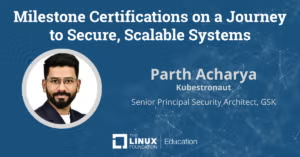
 Milestone Certifications on a Journey to Secure, Scalable Systems
Parth Acharya’s career has progressed from core software engineering and quality assurance into security engineering, cloud security, and ultimately enterprise security architecture. As Senior Principal Security Architect at GSK, he focuses on securing large-scale, cloud native platforms across the company’s global ecosystem. With Kubernetes at the core of these platforms, Parth recently earned Kubestronaut status, adding another milestone to an already formidable list of professional achievements.
Parth’s interest in IT began during his academic years, driven by a desire to understand software systems end-to-end, not just how to use them. He was drawn to how applications are designed, tested, deployed, and operated, as well as to how performance, reliability, and security are intentionally built into systems.
“My early exposure to software engineering and quality assurance helped me develop a strong foundation in application internals, databases, and release processes, which later evolved into a deeper focus on building secure, scalable, and resilient systems,” said Parth
The Criticality of Security Comes Into Focus
Early career positions working in the banking sector made it clear to Parth how critical security is to trust and business continuity. “My interest shifted from how systems run to how they fail and how we defend them,” he said. “As cloud native platforms and Kubernetes became central to modern infrastructure, the added complexity created opportunities for security impact at the architectural level, aligning perfectly with my background and interests.”
That evolution in perspective naturally led to more senior, architecture-focused roles. “This progression led me into principal-level architecture positions, where I design and govern end-to-end security for cloud native and hybrid platforms, including Kubernetes security, CI/CD DevSecOps controls, identity and access management, and CNAPP-based cloud and container protection, aligning security architecture with business and technology transformation at scale,” Parth said.
 Earning Kubestronaut status wasn’t Parth’s intention when he began his pursuit of Kubernetes certifications. “I started with the CKA and CKAD because they aligned with my projects,” he said. “Later, CKS became important for deeper security work, and once KCNA and KCSA were introduced, completing the set made sense and naturally led to achieving the Kubestronaut milestone.”
Parth found that earning the certifications helped formalize and validate his hands-on experience across administration, application design, and security. “Each certification added depth, and collectively they enabled my end-to-end mastery of cloud native systems,” he said.
He believes that the combined impact of earning all five Kubestronaut certifications was even more significant for his career. “It enhanced my credibility in cloud native security discussions, supported larger architectural decisions, allowed me to mentor engineers, and strengthened my role in platform modernization programs,” he said. “And, it reflects both my expertise and my commitment to continuous learning.”
Parth’s high regard for certifications extends to hiring new members for his team. He believes certifications signal readiness and commitment, especially for early-career or transitioning engineers. “Hands-on CNCF certification exams provide confidence that candidates can solve real cluster problems, debug issues, and think cloud natively,” he said. “Experience still matters most, but certifications add strong validation.”
Keys to Certification Success
Parth points out that CNCF exams demand real, hands-on experience. “Kubernetes cannot be learned through theory alone. You have to work with real clusters, break things, and build confidence through repetition,” he said.
Beyond hands-on practice, Parth points to a small set of resources that helped him prepare effectively. Alongside the official Cloud Native Computing Foundation (CNCF) study resources and Kubernetes documentation, he relied on structured learning platforms such as KodeKloud
To test his readiness under realistic conditions, he used exam-focused lab environments like Killer.sh and Killercoda, which simulate real troubleshooting scenarios and the time pressure of the exam itself. He also credits the broader cloud native community – through Slack groups, Discord channels, Kubernetes study circles, and forums – for ongoing problem-solving, exam insights, and motivation throughout the process.
Future Certification Goals
As a senior practitioner and strong proponent of certifications, he plans to continue expanding his expertise by pursuing Golden Kubestronaut status, which requires passing all CNCF certifications. He also plans to pursue architect-level cloud security credentials, AI-for-security certifications, and, as the field matures, programs in quantum-safe cryptography.
“CNCF certifications translate directly into real-world operational and security skills and are a valuable investment for every cloud native professional,” said Parth.
 Parth Acharya, Kubestronaut
Senior Principal Security Architect, GSK

